
How to calculate CBM: cargo volume and weight for a container
To calculate CBM (cubic metres) is the first step in planning any shipment. CBM tells you how much space your goods take, and together with the weight it tells you which container you need and what the freight will cost. This guide shows the formula, a worked example and how to compare your result with a container.
Key facts
- What it is: CBM means cubic metres. It tells you how much space your goods take in a container.
- Formula: CBM = length (m) x width (m) x height (m). If you measure in centimetres, divide the result by 1,000,000.
- Example: A 60 x 40 x 30 cm carton is 0.072 CBM. 400 cartons make 28.8 CBM. This is an illustration of the method, not a product size.
- Why it matters: With the weight, CBM decides which container you need and what the freight costs.
The CBM formula
For one carton or package, multiply length by width by height, all in metres:
CBM = length (m) x width (m) x height (m)
If you measure in centimetres, divide the result by 1,000,000. For the whole order, multiply the CBM of one package by the number of packages.
A worked example
A carton measures 60 cm x 40 cm x 30 cm. That is 0.6 x 0.4 x 0.3 = 0.072 CBM. If your order is 400 cartons, the total is 400 x 0.072 = 28.8 CBM. Weigh one carton and multiply by 400 to get the total weight. This example is only an illustration of the method: your real carton sizes and weights come from the product specification in your quote.
Volume and weight: check both
A container has a volume limit and a weight limit. Whichever you reach first decides the container.
- Typical 20ft container: about 33 CBM and about 28 tonnes of payload.
- Typical 40ft container: about 67.7 CBM and about 26.7 tonnes.
- Typical 40ft high cube: about 76.4 CBM and about 26.5 tonnes.
Heavy goods such as tiles and steel reach the weight limit first. Light bulky goods such as sanitaryware and plywood reach the volume limit first. See container sizes for the dimensions.
Allow for packing and stacking space
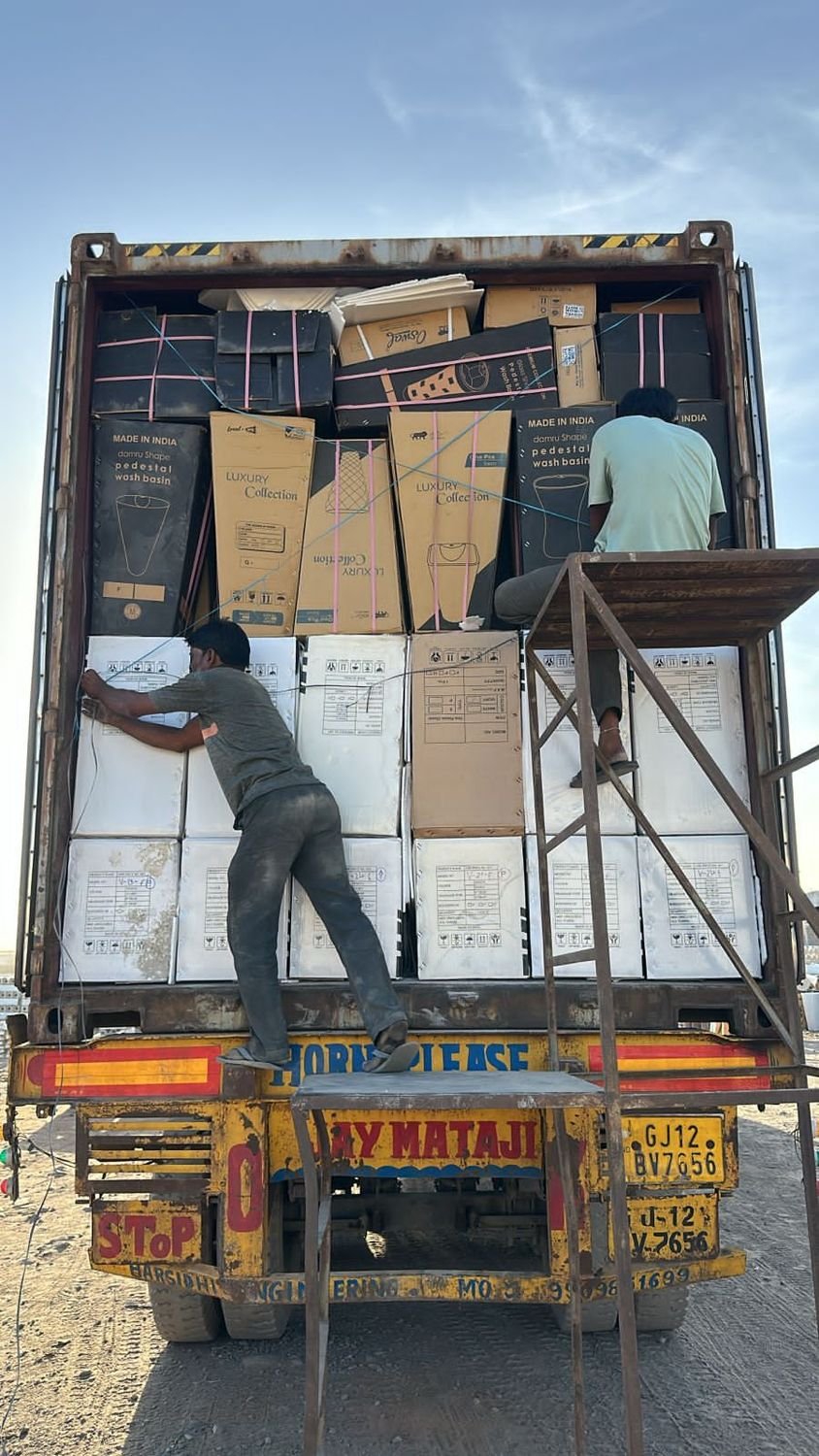
Real loads never use 100% of the volume. Pallets, gaps, wrapping and the need to keep fragile items upright take space, so your calculated CBM should be lower than the container’s volume. Ask your supplier for the packed carton sizes and weights, not the product sizes.
Chargeable volume for LCL
For shared containers, freight is charged on whichever is greater: the actual volume or the volume equivalent of the weight. Read the guide to FCL vs LCL before you choose.
Frequently asked questions
How do you calculate CBM?
Multiply length by width by height in metres. For the whole order, multiply the CBM of one package by the number of packages.
How do I calculate CBM from centimetres?
Multiply length, width and height in centimetres, then divide the result by 1,000,000.
Can I fill 100% of a container's volume?
No. Pallets, gaps, wrapping and the need to keep fragile items upright take space, so your calculated CBM should be lower than the container volume.
Do I need the weight as well as the CBM?
Yes. A container has a volume limit and a weight limit, and whichever you reach first decides the container.
How is LCL freight charged?
For shared containers, freight is charged on whichever is greater: the actual volume or the volume equivalent of the weight.
Get a quote for your container
Tell us the product, size, quantity and destination port. A named export manager replies with a specification, price and lead time. Request a quote, download the free import checklist or message us on WhatsApp.
Planning an order? Ask for a quote.
Tell us the product, quantity and destination. A named export manager replies with specifications, price and the import documents for your country.
Prefer to chat? Message us on WhatsApp.